One deck, several rooms. Choose a category or a meeting; the deck hides what that room does not need and adapts its opening slide.
By audience
By meeting, in date order
Currently showing: every slide
← → build/slide · ↑ ↓ section · B builds off · O overview · N notes · F present
RuBase · reading Russia at machine scale
Not a software demo. An argument about what our field currently cannot see, and an open invitation to the machinery that fixes it.
Stephan De Spiegeleire · HCSS Datalab · city · date
Stephan De Spiegeleire · HCSS Datalab Adam N. Stulberg · Professor and Chair, Sam Nunn School of International Affairs, Georgia Tech
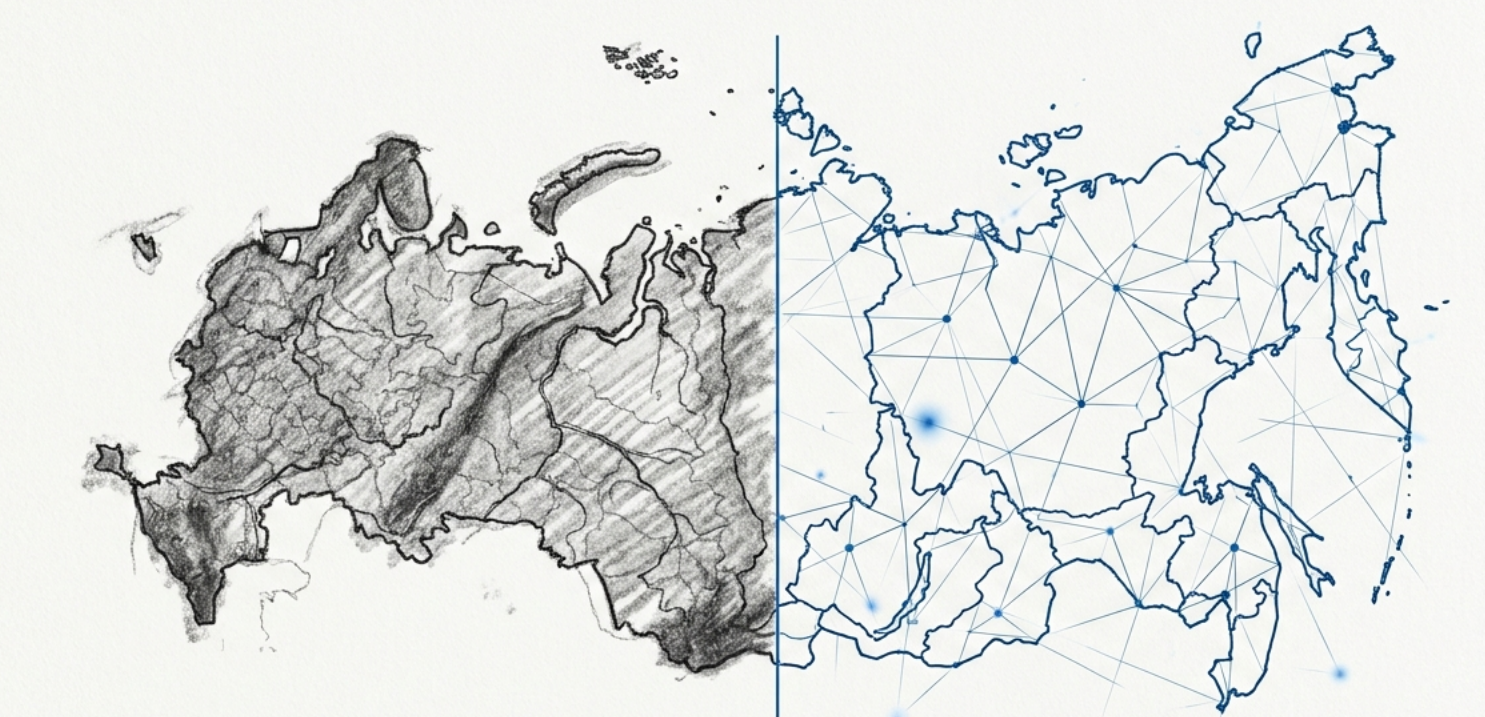
The picture is one country read two ways: by hand, one document at a time, and by machine, as a structure you can interrogate. RuBase is the platform, not the finding. Everything that follows is a finding the platform made possible, and each one arrives with the method that produced it.
Where this ends
“Here are the problems our field has, here is how we have tried to solve them, and we are open about sharing all of it.”
The close, said first
That sentence is where the next forty minutes end, so it goes on screen before they start. Saying it first turns a sequence of demos into a single argument you can hold on to, and it makes the offer at the end feel earned rather than tacked on.
1The gap our field facesPolicy and scholarship, both reading a fraction
2What RuBase actually isAn architecture, not a product
4The corpus nobody has seenThe evidence base, finally measured
5How we can help youThe offer, and what it asks of you
Five moves, in this order for a reason
Moves one and two earn the right to show anything at all: the gap has to be felt in your own work before an architecture reads as more than a tool demo. The three cuts then do the proving, and move four turns the instrument back on the literature itself.
Cut one · Red Lines
This one proves the machinery can produce a disciplined null and then tell you what to do instead. It is not a case study about Russia so much as a proof about method: the honest answer here was that there is no correlation, and the architecture is what let us say so and show the working.
Cut two · WACKO
This one proves the machinery can find something no human with Ctrl‑F could find. Same corpus discipline, opposite result: where Red Lines returns a null and defends it, WACKO returns a structure that was in the material all along and unreachable by reading.
Transparent Battlefieldaudience-dependent · no figures quoted here
Cut three · Transparent Battlefield
The third cut is audience-dependent and rides on its own architecture deck rather than on slides built here, so nothing is quoted from it until those numbers have been read and checked. Each cut runs five to seven minutes.
Everything is open, in Russian, and nobody can read it
Analytical staffs do not lack Russian sources. They lack any way to read them.
296,381 chunks
The Russian officialdom corpus runs to 296,381 chunks. Each dot here stands for about 285 of them. No analyst and no ministry section reads a field this size by hand.
28 Telegram categories of 51 ingest arms, 11+ languages
Those documents come from 28 different kinds of source in eleven or more languages. Coverage that wide is what lets you ask what Moscow is saying, rather than what one outlet happened to print.
Only 2.563% passes the screen
Just 7,596 of them, the 27 gold dots, carry a nuclear-security statement. The signal fraction is the point: 97% of what you would have to read to be thorough is not worth your time, and you cannot know which 97% without reading it.
So everyone reads the slice
Faced with that, every ministry does the same rational thing and reads the translated, pre-selected slice that reaches its desk. That slice was chosen by someone whose criteria are unstated and whose coverage was never measured.
What the substitution costs
You inherit another organization’s selection bias and you cannot show your work, which matters most exactly when the reading is contested. An institution justifying its reading of Moscow to a minister, a parliament or an ally has to answer three questions: what did you read, what did you leave out, and why? A curated feed cannot answer any of the three.
Small N, one coefficient, and a reading list nobody audited
A hand-coded sample, one variable on another, drawn from a literature nobody has read whole.
A field of 264,000 works
The published Western literature on Russian foreign, security and defense policy measures 264,000 ± 13,000 distinct works, a 95% confidence interval of 251,156 to 277,280. Every dot in that block is a thousand of them. No individual, no seminar and no literature review has read a meaningful fraction of it.
Four fifths of it is scholarship
Of that total, 204,000 ± 12,000 are scholarly works – the gold dots, about seventy-seven per cent of the block. So “the literature says” is in practice a claim about the few hundred works somebody happened to encounter, standing in for two hundred thousand nobody counted.
The field against its neighbor
Our 2021 ASEEES bibliometrics measured 9,130 RFSDP publications carrying 30,879 outward references, against an area-studies comparator of 429,038 publications carrying 1,122,391. The bars are drawn to scale, which is why ours are the slivers. Dividing one count by the other gives a comparator 47 times larger by publication and 36 times by reference.
One variable on one variable
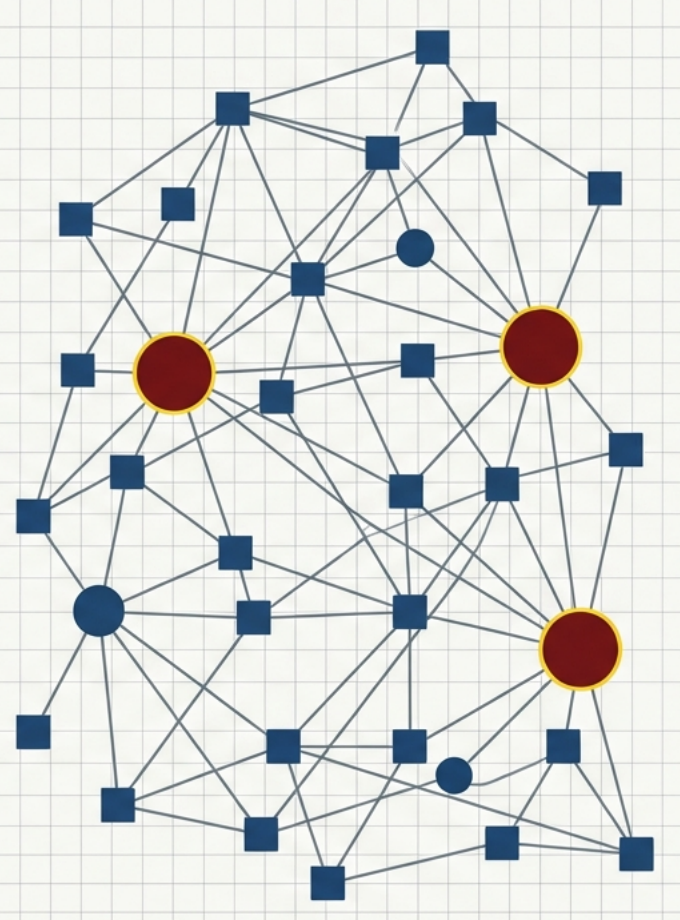
A field that small defaults to the designs it can hand-code: one dependent variable, one independent variable, and an N set by how much coding a graduate student can survive. This panel is a schematic of that design, not a plot of anyone’s data.
THE READING LIST, AT THE POINT OF USE
And the reading list itself
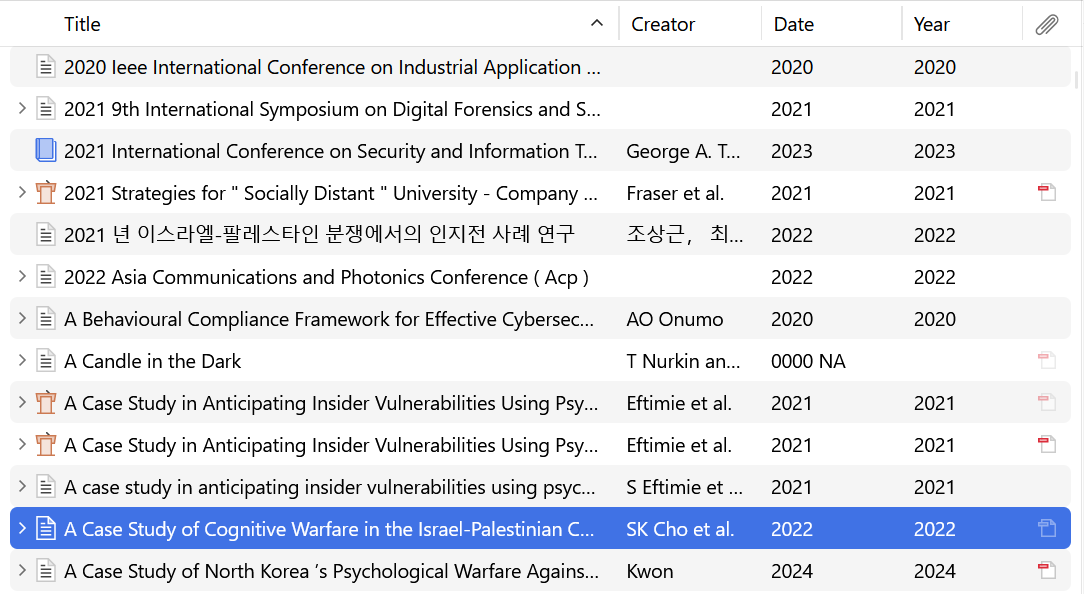
This is an evidence base where it is actually used: a working reference library with three near-identical duplicates visible in this one window. Nothing in the ordinary workflow checks it against the 264,000.
None of these three numbers came from reading
The size of the literature, the size of the field and the shape of the reading list were all produced by counting the record rather than by reading it. That is the scholarly gap: not that anyone is lazy, but that the field has never had an instrument that could see its own evidence base whole. Everything after this slide is about building one.
What RuBase actually is
Not a product that closes the gap – an architecture that makes reading everything traceable.
Six routes, not fifty-one arms
An arm is an acquisition route: a reusable way material enters the collection. The database’s 51 values are legacy ingest labels that mix routes, platforms, projects and source types; presenting them as equivalent arms turns an implementation column into a false taxonomy.
A channel is a source, not an arm
Telegram is one acquisition route containing 339 identifiable channel names. The old 28 Telegram labels are overlapping editorial buckets, and 24 channels occur under more than one of them. A source is therefore stored once and described along several independent dimensions rather than forced into one brittle branch.
The screening rate belongs to a nested corpus
2.563 percent is not a property of all 2.07 million documents. It is the measured result of one relevance screen over 296,381 chunks of Russian officialdom. Keeping container, source structure and analytical subset separate is what makes the denominator defensible.
Four stages, not four features
Harvest everything, filter by a rule you can state out loud, structure what survives, and read it in a way that leaves a receipt. RuBase is that sequence, not any single tool inside it. Swap the corpus and the sequence still holds, which is why it can be pointed at your question rather than only at Russia.
What “structured” looks like
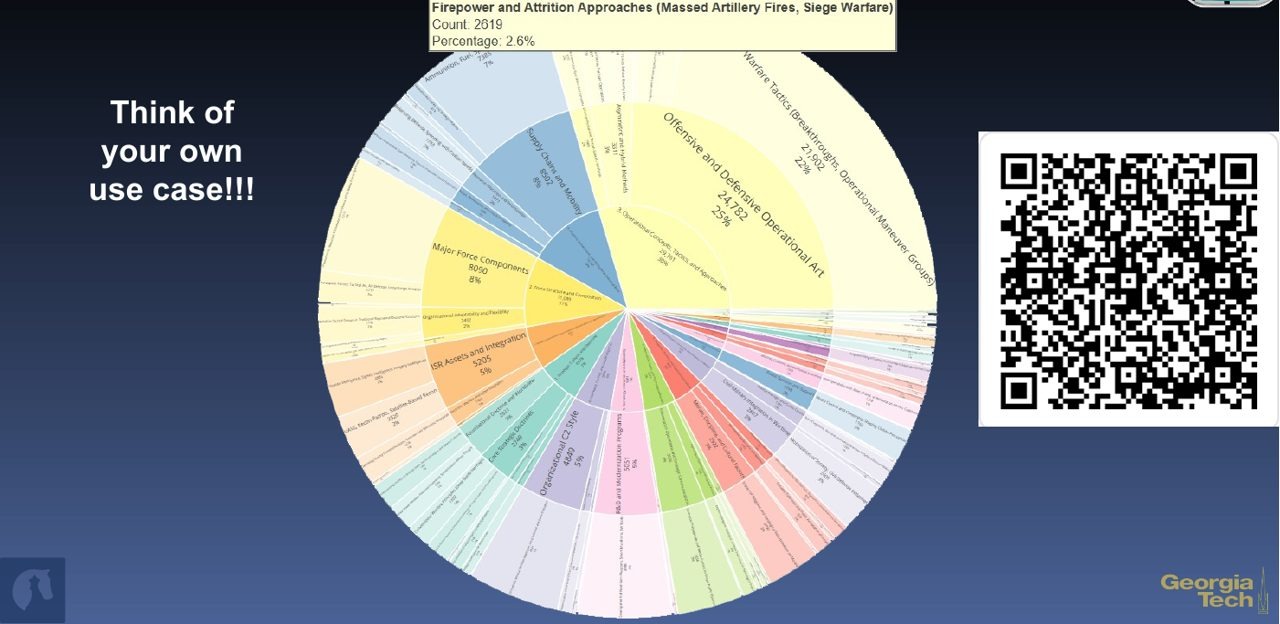
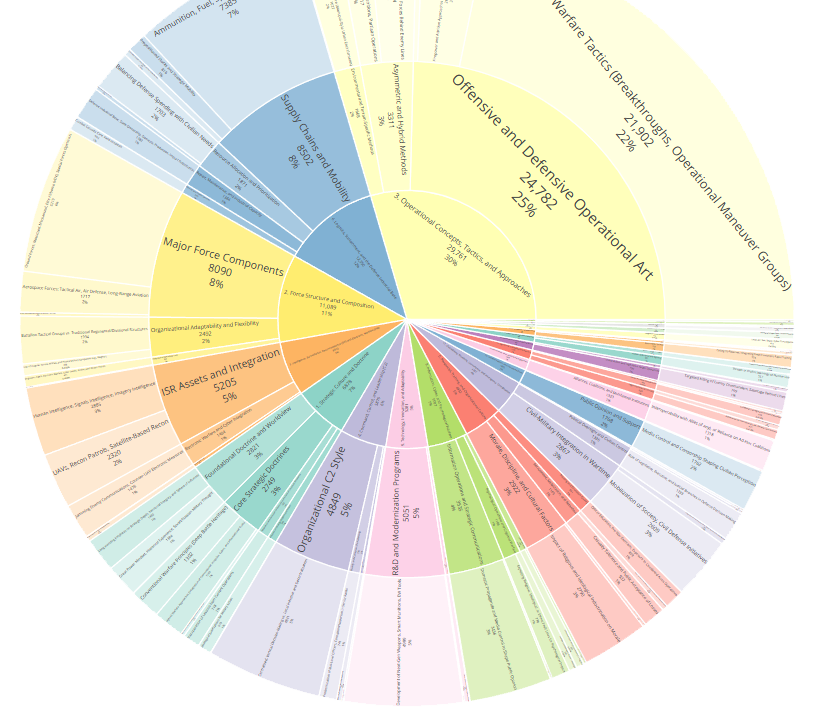
Every ring is one level of the taxonomy and every wedge is sized by how much of the corpus falls under it. You are looking at the shape of a literature nobody has read end to end.
This is an argument, not a demo
None of this is a finding. It is the machinery that lets a finding be checked – you can say what entered, who produced it, what was selected and why. What follows are three cuts that came out of it, including one where the honest answer was that there is no correlation.
Spiral development, not a waterfall
How RuBase actually got built, and how a new question enters it.
Turn 1 · a question
One analyst’s question, answered by hand against a corpus that is too big to read.
Turn 2 · an instrument
The reading is turned into a taxonomy and a screen, so the next question is cheaper.
Turn 3 · a corpus
The screen runs at scale, and what it misses becomes the next question.
Turn 4 · a service
The loop is handed over, so the question no longer needs us to be in the room.
Each turn is a full pass, not a phase gate. The instrument is a by-product of answering a real question, which is why it survives contact with the next one.
Three substantive cases
Red Lines, WACKO, Transparent Battlefield – each one runs the same three beats, in the same order.
1 · Research question
What we are actually asking, in one sentence a sceptic can hold us to.
2 · Data sources
Which corpus, how large, screened how, and what it cannot see.
3 · Substantive findings
What the evidence supports, with its confidence and its boundary.
What a red line actually is
Before any method: what we count, and what does not count. Putin’s own statements, 2000 – 2026.
The two-part test
A statement is counted only when it names a boundaryanda threatened consequence, each scored independently. Both, or it does not enter the set.
What that yields
246 red-line statements across 157 documents. Separately, 91 nuclear-threat statements across 75 documents.
They are not the same register
Only 43 documents carry both. 114 of 157 red-line documents – about 73% – contain no nuclear threat at all.
Red-line documents
157
Nuclear-threat documents
75
Documents carrying both
43
The nuclear register is a small overlap, not a synonym. Treating every red line as a nuclear signal is the most common error in reading this material.
What we looked for and did not find
Sixteen tests against the obvious external drivers. None of them survives.
The tests
Monthly red-line and nuclear counts against Western aid allocations and territorial control, at lags of 0 – 3 months. Sixteen tests, corrected for multiple comparisons.
The result
0 of 16 survive correction. Every correlation is |ρ| ≤ 0.31, and the aid coefficients flip sign between adjacent lags – the signature of noise.
The one we report anyway
Territorial pressure against red-line talk is nominally significant at lag 0 (ρ = 0.309, p = 0.023) and fails after correction (q = 0.367). In the expected direction. We print it.
What does move together
The two rhetorics track each other: ρ = 0.395 (p = 0.013) over 39 months since 2022. They overlap on discrete occasions rather than running independently.
The rhetoric is not a reaction to aid or to the front line, at any lag we tested. Whatever drives it is not the obvious thing.
The boundary, stated first rather than when challenged. The instrument only sees statements built the canonical way. Coercion that deliberately declines that structure is invisible to it by construction – so a shift toward deniable signalling would look exactly like this null. Two such cases sit in the corpus and yielded nothing: October 2023 and November 2024.
It is not the interaction
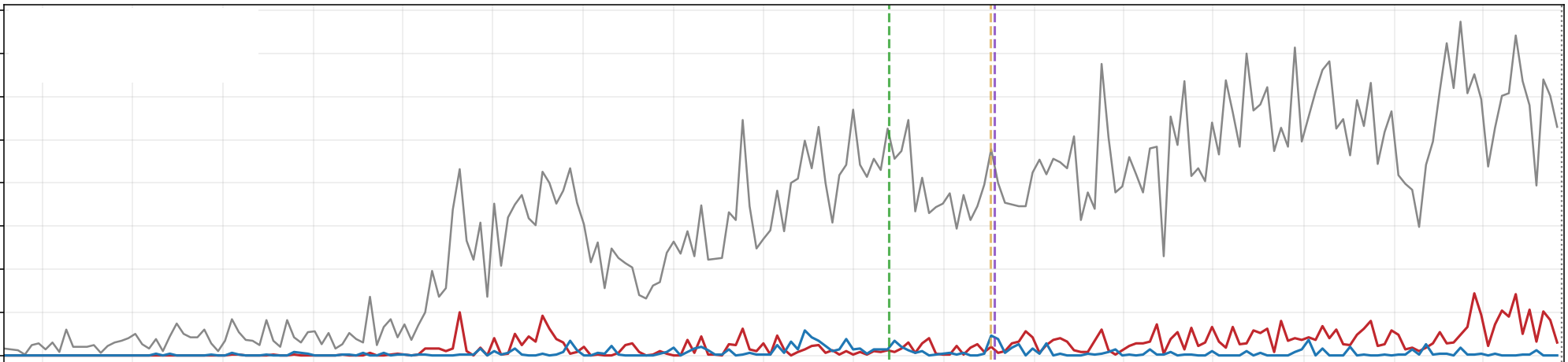
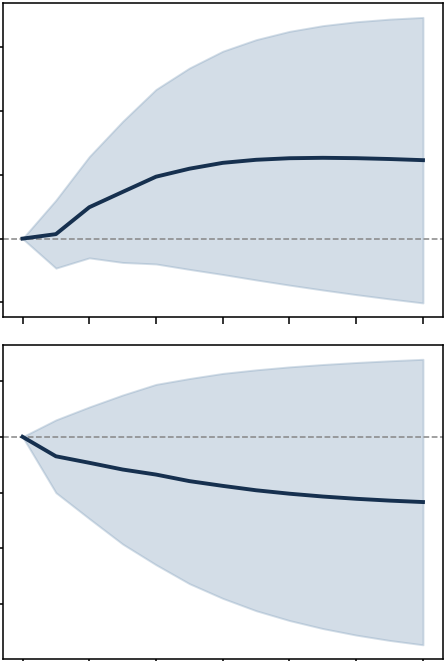
Five estimators over 226 weeks: Ukrainian strikes do not move Russian nuclear or red‑line rhetoric as our instrument defines it – and a null you can defend, with its blind spot named, is a finding.
UA strikes on Russia, weekly all>600 km deepWestern‑supplied
400
200
0
2023
2024
2025
2026
Cumulative impulse responses, RuBase Red Lines causal battery; strike series verified to 19 Jun 2026.
The physical campaign, 226 weeks
Ukrainian strikes on Russia climb from a handful a week in 2022 to roughly 300–400 a week in 2025–26, 35,630 verified incidents in all. The escalation‑spiral worry is about exactly the two lower series here: strikes beyond 600 km, and strikes flown with Western‑supplied weapons.
Russia proper
RED_LINES
NUCLEAR_THREATS
0 to 12 weeks after the shock · shaded band = 95%
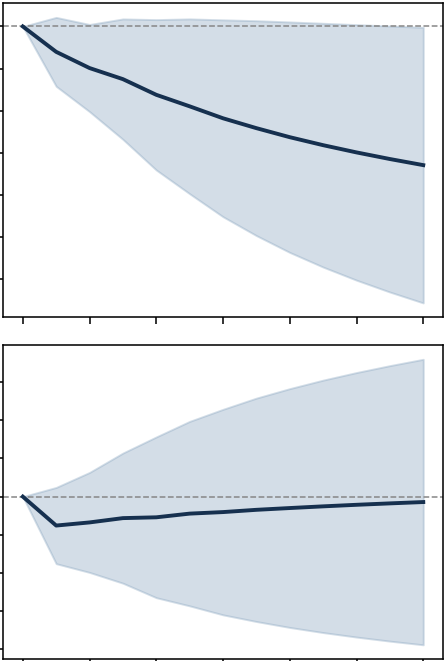
Strikes on Russia proper
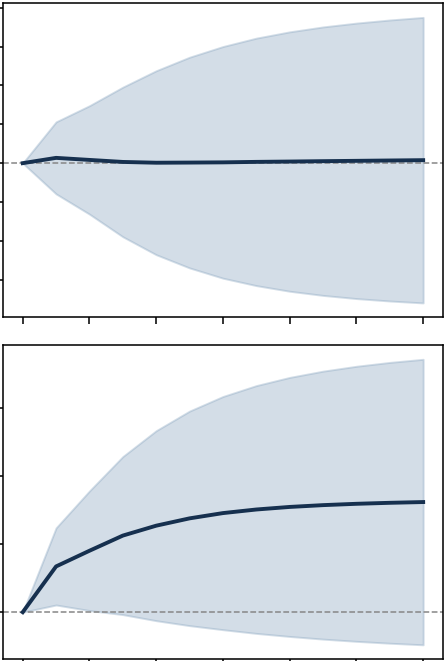
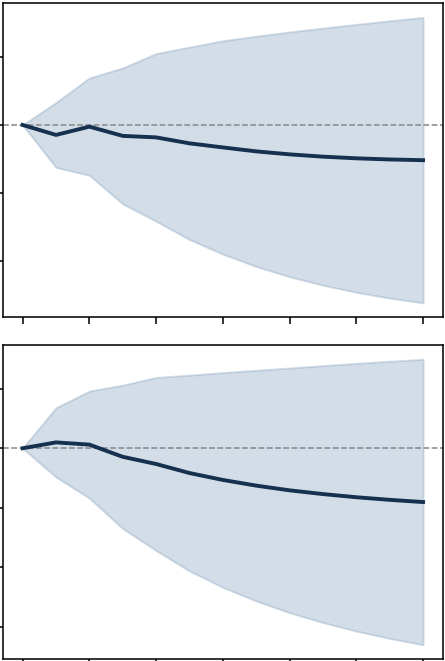
Each column shocks one slice of the campaign by one standard deviation and traces the twelve weeks that follow. Top row, red‑line statements; bottom row, nuclear threats. The band is the 95% interval, and it swallows the dashed zero line.
Western‑supplied
The one honest flicker
This is the slice the escalation worry is really about, and the only one that moves at all: nuclear threats drift to +0.31 on a ±0.38 band, Granger p = 0.07. It does not survive the controls, and we report it rather than promote it.
Annexed territory
Strikes on annexed territory
Moscow calls this Russian soil, so its own doctrinal claim predicts the sharpest reaction here. The response is flat to mildly negative, and the interval covers zero across all twelve weeks.
Refineries, energy
Eight panels, eight bands over zero
Pairwise Granger survives no FDR correction. A FAVAR carrying 76% of the variance of 23 controls returns p ≥ 0.16 for every strike driver, and LASSO keeps no strike driver for red lines at all.
November 2024
What does fire
Enter that one week as an exogenous event and it predicts nuclear threats at +1.79, p < 0.001. It bundled the ATACMS authorization, Russia’s revised nuclear doctrine and the Oreshnik launch – and the strike line does nothing unusual there.
So it is not the interaction between the actors
VAR, FAVAR, LASSO‑VAR, Ridge and VARX agree that no slice of the strike campaign robustly moves the rhetoric, and a graph‑learned Granger screen on the same data reproduces the absence without being asked to. What the rhetoric answers to is its own past and other discourse – which is why the next move is not a better coefficient, but a network of variables.
From one coefficient to a pattern of variables
The last move in the Red Lines cut – and the one the other two cuts are built on. Twenty‑nine weekly series, 226 weeks, and a question the two‑variable design cannot ask.
One X against one Y
Asked the ordinary way, the question is whether Ukrainian strikes move Russian red‑line rhetoric, and the ordinary way to test it is a bivariate Granger screen on the two series. On 226 deduplicated weeks that screen fires, minimum p = 0.0003, and it is stable across windows. Written up as it stands, this is a finding.
The same pair, inside the system
Neither series changed. What changed is that everything else is now in the model: five factors carrying 76% of the variance of 23 controls absorb the effect outright, leaving RRLS at p = 0.21 and NTS at p = 0.09, with LASSO and Ridge at noise level. The arrow was real. It was not causal.
Twenty‑nine series, not two
The battery runs 29 weekly series across 226 weeks and 58 lagged predictors. Once they are all in, the question stops being whether X moves Y and becomes what this system does when it is left to run. The nodes named here are the ones the screen returns; the block on the right is the rest of them.
What actually predicts the rhetoric
The graph‑learned screen finds the drivers of red‑line rhetoric among other discourse: AIDS, ARMS, CONTROLS, THREATENS, ATTACKS and DISPLACES, with ATTACKS also reaching nuclear threats. Read the shape, not the six edges. They are bivariate and uncontrolled, and they do not survive the multivariate controls.
One edge runs the other way
Red‑line rhetoric predicts LAUNCHES at p = 0.002, so here the talking precedes the launching rather than following it. Its own strongest predictors are its lagged self, which is what a deliberate signalling instrument looks like and not what a thermometer of the battlefield would look like.
The finding is an absence
STRIKES appears nowhere in this network as a driver of the rhetoric, not even at the permissive bivariate level where the weaker edges above survive. A second and methodologically distinct method reproduces that absence without being asked to: the graph was fitted to predict links, not to answer this.
From a coefficient to a pattern of variables
One variable against another can only return a number, and on this data it returns a number a fuller model deletes. A field of variables returns a shape you can argue with: what drives what, what is talking to itself, and what is simply not connected. That is the methodological claim of this cut, and the two cuts after it rest on it.
Picking and choosing
WACKO · the Kremlin does not adopt a philosophy. It runs a sieve, and the sieve is visible only from both sides.
The whole canon goes in
The input is the entire philosophical inheritance a regime could draw on, not the handful of thinkers a commentator happens to name. It arrives complete, with its internal contradictions, its esoteric foundations and the doctrinal obligations it would impose on anyone who took it whole.
The sieve is the regime’s own red lines
Between the canon and the official record sits a filter nobody publishes: which ideas may be said, in which venue, how explicitly. WACKO reconstructs it from the corpus, by reading what the canon offers against what the record says.
What never gets through
What is thrown aside is the most diagnostic part: uncomfortable history, explicit authoritarian doctrine, the ethnogenesis that would pin the regime down. A keyword search cannot see any of it, because none of it is in the text you search.
The curated repertoire
What survives is not a worldview but a working repertoire: actionable frames, civilizational leadership, justification for intervention. The selection is consistent enough to be a rule rather than a taste – a rhetorical economy that takes whatever mobilizes and drops whatever would bind.
None of this is a quotation you could have looked up
The shape only appears when the whole canon and the whole official record are read against each other, so that the absences count as evidence. That is what a corpus buys that a reading list does not: it lets you be systematic about what is missing, and being systematic about what is missing is the entire finding.
Motivating, or rationalising?
WACKO · the substantive question the corpus exists to answer, and its honest status.
The question
Is Russian exceptionalism a motivating belief for the Kremlin, or a rationalising vocabulary applied afterwards?
Why it is answerable
A motivating belief should appear before the decisions it explains. A rationalising one clusters after them.
What the instrument adds
Reading for the idea rather than the name gives the timing of a concept that is rarely named at all.
The honest state
This is the test the corpus makes possible. We have not run it yet, and it is the next thing worth running.
120 echoes, 15 mentions
WACKO · what a keyword search of the Kremlin corpus can reach, and what it cannot
What a keyword search can reach
Search the corpus for his name. A string match returns only where somebody chose to write it down: deliberate citations.
Fifteen literal mentions
The name comes back fifteen times. Read them in an afternoon and you would reasonably call the thinker marginal.
The idea keeps moving without the name
The same idea keeps working in passages that never name its author. Seeing them means reading for meaning, not string.
A hundred and twenty semantic echoes
Reading for the idea returns a hundred and twenty passages. Each dot is one, sized like a literal mention.
None of it is reachable by string
No keyword search or citation index could assemble that field. What is counted is never written down.
Why this cut is in the deck
WACKO is not here to teach you Russian philosophy. It is here because the distance
between fifteen and a hundred and twenty is visible only to an instrument that reads everything
for meaning, and because that distance changes the answer – from a marginal citation to a
load-bearing one. The question to carry away is about your own evidence base: what would its
Ctrl-F count have missed?
The ratchet effect
Escalation is a step change, not a climb. Echo Saturation Rate by year, Russian officialdom.
Six periods, one measure
The bands are the report’s own periodisation. The line is the share of text chunks carrying an ideological echo – not a count, so corpus growth is divided out.
A settled level, for six years
From consolidation through the constitutional era the signal never clears 4.2%. The 2.0% trough is COVID closing the institutions that produce the content.
Then one year adds nearly five points
2022 lifts it by 4.86pp – more than the entire preceding range. The third wave does not extend the plateau; it leaves it.
And the floor holds
The lowest year since is 8.7%, above every year of the plateau. By 2025 it reaches 11.8%.
What the dashed ends are, and are not
Before 2016 the corpus is 257–307 chunks a year against 3,181–6,620 later, so those rates sit on a very small base. 2026 is a part year. Neither end carries weight; the middle does.
The naturalisation gap
Ideas travel without names – and how far depends on the venue.
Where the ideas land
Every venue carries thousands of unattributed echoes – a philosopher’s argument appearing without the philosopher.
Where they are credited
120 literal namings in the entire corpus, over fourteen years. The gold marks are drawn to the same scale as the blue bars. That is why you can barely see them.
The gap differs fourfold by venue
The deliberative chamber credits its sources about four times as often as the presidential and Telegram channels. Attribution is a property of the venue, not of the belief.
One naming per 182 echoes
This is precisely what a keyword search cannot reach: the vocabulary is everywhere, the names almost nowhere. Searching the corpus for a philosopher finds a rounding error.
The strategic ledger
What the regime takes from the canon – and what it leaves behind.
What gets amplified
Frames the regime uses more heavily than the canon supplies them. Operational Application runs at ×8.56: doctrine about what to DO.
What gets held down
Imperial Era ×0.03. Religious Philosophy ×0.04. Slavophile School ×0.05. The theological and historical core of the canon barely reaches official speech. Even Orthodox Christianity runs at ×0.23.
The Ilyin gap
The thinker they quote is not the thinker they use.
The canon, by volume
How much of the philosophical corpus each thinker actually supplies. Dugin leads with 1,317 chunks, then Khomyakov and Leontiev.
Now: who officials actually name
A different order entirely. Ilyin – fourteenth by volume – is named 19 times, more than anyone. Four of the biggest contributors are not covered by the name detector at all, so nothing is claimed about them.
The citable face
The regime has a thinker it is willing to quote, and it is not the one supplying most of the material. Leontiev: once per 502 echoes. Ilyin: once per 10.
Decoding the silences
What the canon supplies in volume and officialdom never says at all.
Loud in the canon
Each of these is echoed dozens to hundreds of times across the philosophical corpus. They are not marginal ideas.
Silent in the state
Zero officialdom echoes – every one. Including Dugin’s Fourth Political Theory: the vocabulary travels, the doctrine does not. The omissions are as diagnostic as the citations.
Where the echoes come from
The pipeline is not stable – it moves.
A deliberative start
In 2016 the ideological signal sits overwhelmingly in the Federation Council – committee hearings and expert testimony.
A Telegram end
By 2025 the same discourse has migrated to rapid-response channels. The venue shift is the story: same ideas, different room, different rules.
What kind of ideology
Not just how much – which registers, and when.
The two dominant registers
Across a decade, two top-level categories carry most of the officialdom signal. The taxonomy lets you ask which KIND of idea is moving.
And the rest
The remaining categories move independently. A single “more ideology” number would hide every one of these shifts.
What this is measured on
Two corpora, and the whole method is the comparison.
The two sides
101,352 chunks of philosophical text from the canon, against 56,931 chunks of Russian official speech across four venues.
Why both are needed
Reading officialdom alone tells you what was said. Reading the canon alone tells you what was available. Only the pair tells you what was chosen.
The WACKO forecasting framework
Four conditions that, in sequence, precede a major move.
Condition 1 · the filter
Does a new frame clear the regime’s own red lines – actionable, and not binding?
Condition 2 · the pipeline
Does it migrate venue, from where things are floated to where they are legislated?
Condition 3 · the trigger
Is there an event it can be attached to? The machine responds to framability, not to severity.
Condition 4 · the timing
Is the build-up happening before anything kinetic? That is the part that makes it a forecast rather than a commentary.
The honest boundary
All four together are claimed to indicate planned intent. This is a stated framework, not a measured result – unlike every other slide in this section, and it should be said out loud.
What we read, and what they mean by it
Transparent Battlefield · the evidence base first, then the concept as Russian writers use it.
What we read
Russian military and milblogger writing on persistent observation, from a collection of 2,073,843 documents across 51 ingest arms.
How it was screened
Taxonomic annotation over 156,164 transparent-battlefield labels and 62,802 first-pass records.
What the term means to them
Prozrachnoye pole boya is written about as a problem of concealment and dispersal, not as a sensing opportunity.
The lesson they draw
Movement is the vulnerability. The answer is dispersal, deception and tempo, not better sensors.
The battlefield went transparent
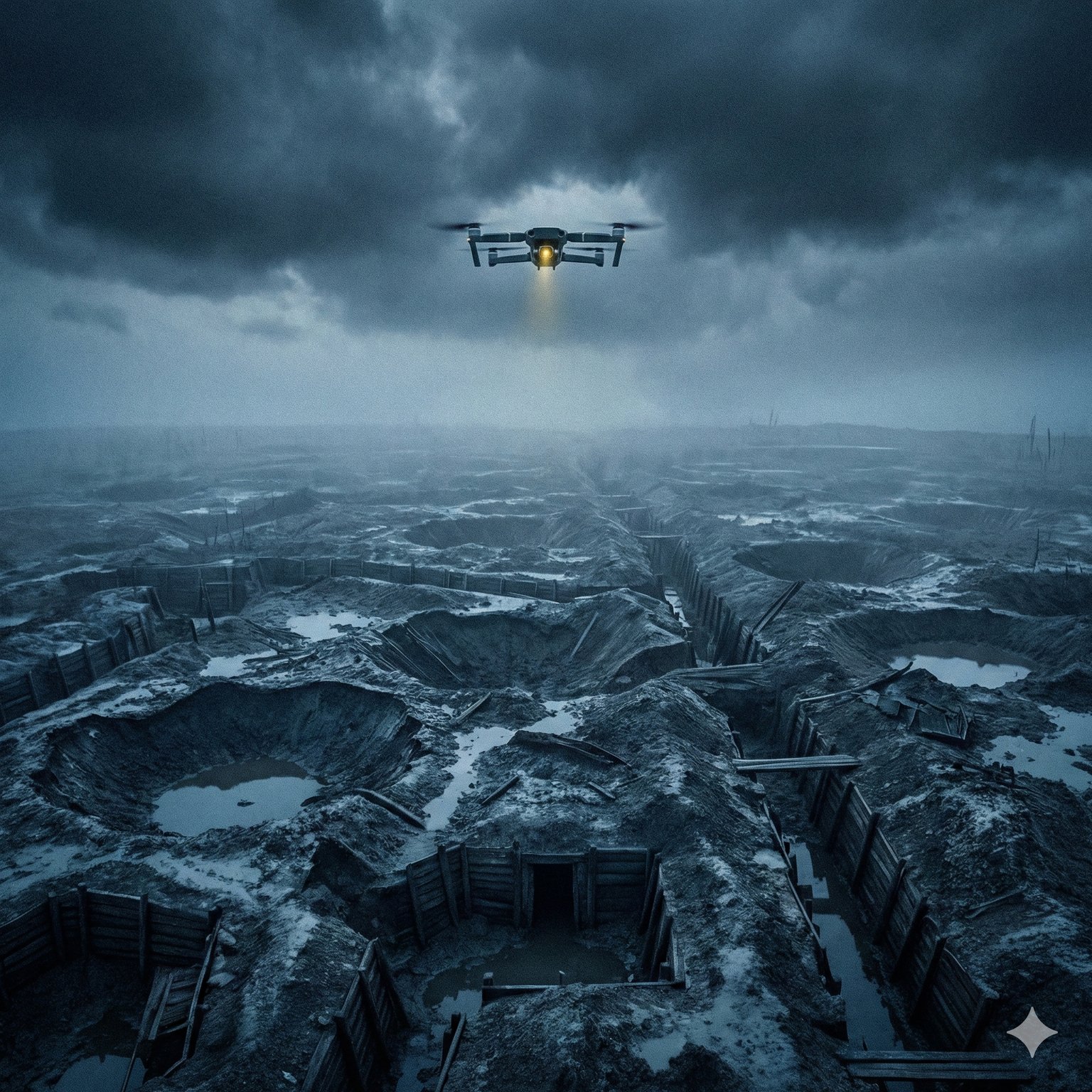
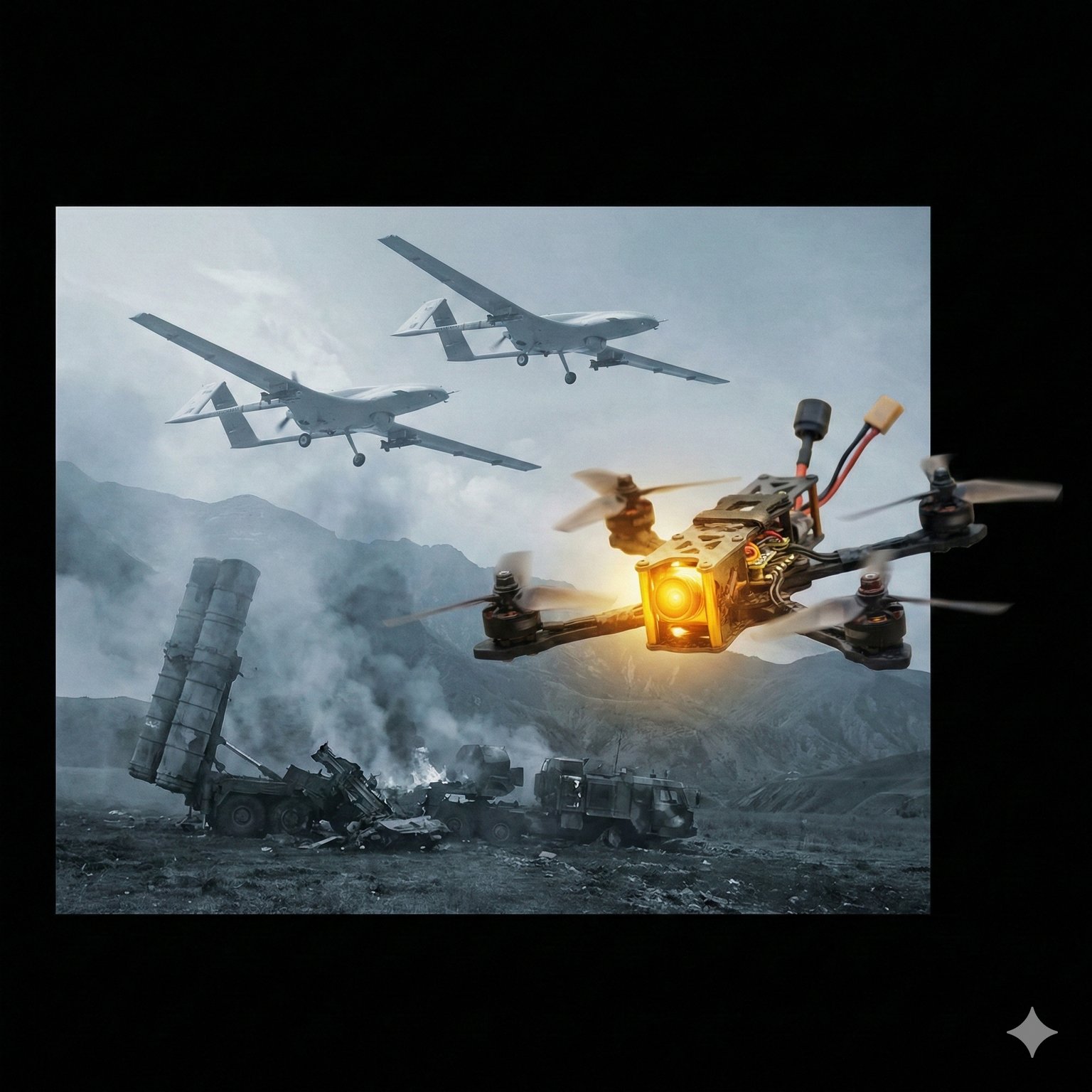
Persistent overhead observation, a shrinking interval between being detected and being struck, and what that does to anyone who still has to move or mass.
Somebody is overhead, continuously
The first thing that changed is not a weapon but a condition. Cheap Class I and Class II drones, FPV variants among them, pushed reconnaissance down to squad level after 2022, so the sky over the contact line is occupied rather than occasionally visited. Russian sources add that Western satellite coverage gives Ukraine a persistent overhead view they concede they cannot match at equivalent scale.
Seeing stopped being a state monopoly
A commercial quadcopter costing a few hundred dollars now does work that once required a strategic reconnaissance aircraft, and a volunteer geolocating a Telegram video feeds the same picture. Russian military writers treat open‑source intelligence not as a curiosity but as a critical, pervasive sensor network. The collection layer now includes people who appear in nobody’s order of battle.
To be seen is to be fixed
Detection on its own is only half of it. ISR feeds, signals intercepts, open‑source imagery and ground sensors are fused algorithmically into one operating picture, and the Reconnaissance‑Strike and Reconnaissance‑Fire complexes that were doctrinal abstractions in 2014 now run as working systems. The bottleneck is no longer the sensor, which is everywhere, but the decision.
The gap between seen and struck
In 2014 the detect‑to‑destroy cycle was counted in hours. Russian military writing now describes aspirational timelines of seconds, and that word carries weight – it is what the discourse claims for itself, not an average we measured. The direction, though, is not in doubt, and everything else on this slide follows from it.
There is no rear any more
Depots, fuel, command posts and transport hundreds of kilometers back now sit inside the reach of precision strike cued by persistent ISR, so the logistical sanctuary is operationally gone. The corpus goes one step further than that: measured per hour of exposure, the resupply run has become more lethal than frontline combat itself.
And it presses on the people
Units that move are detected, units that are detected are struck, so units that intend to survive do not move – Russian sources name that paralysis plainly, and call resolving it the central tactical problem of the war. Alongside it the corpus records a cognitive transparency: knowing you are permanently watched produces decision paralysis and erodes trust between ranks, with no strike landing at all.
Transparency did not speed war up. It froze it.
Network‑centric theory predicted that seeing everything would deliver fast maneuver warfare. What this corpus records is the opposite: forces disperse, dig in and revert to positional attrition, which is why the front reads more like 1916 than 1991. That is the phenomenon. What armies then do about it – and what the answer costs them – is the next slide.
Concealment comes back – as a product
The closing move of Cut 3. Transparency provoked a counter‑transparency race, and the race is being argued out in public, in Russian, in a record dense enough to count.
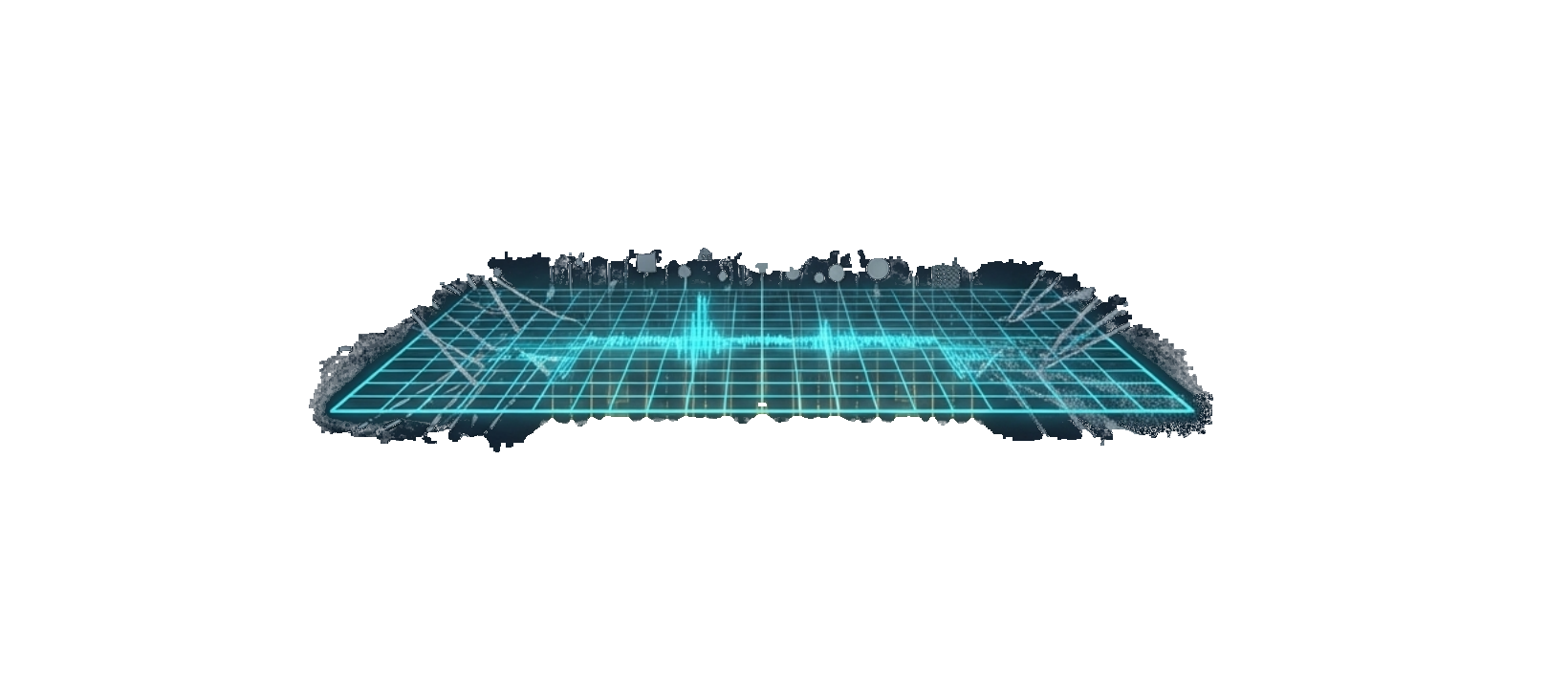
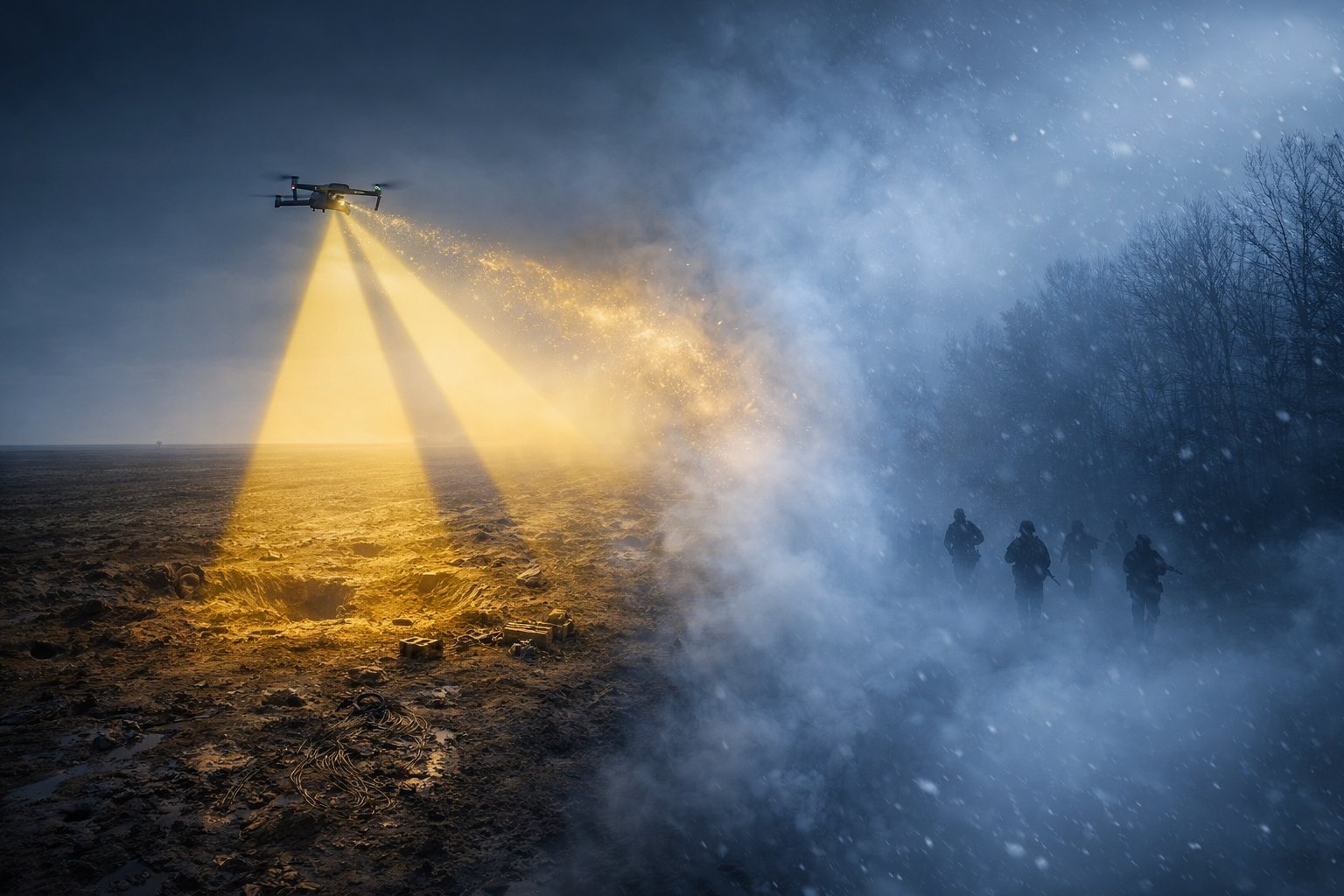
nothing hidden
obscurity, manufactured
Obscurity stops being free
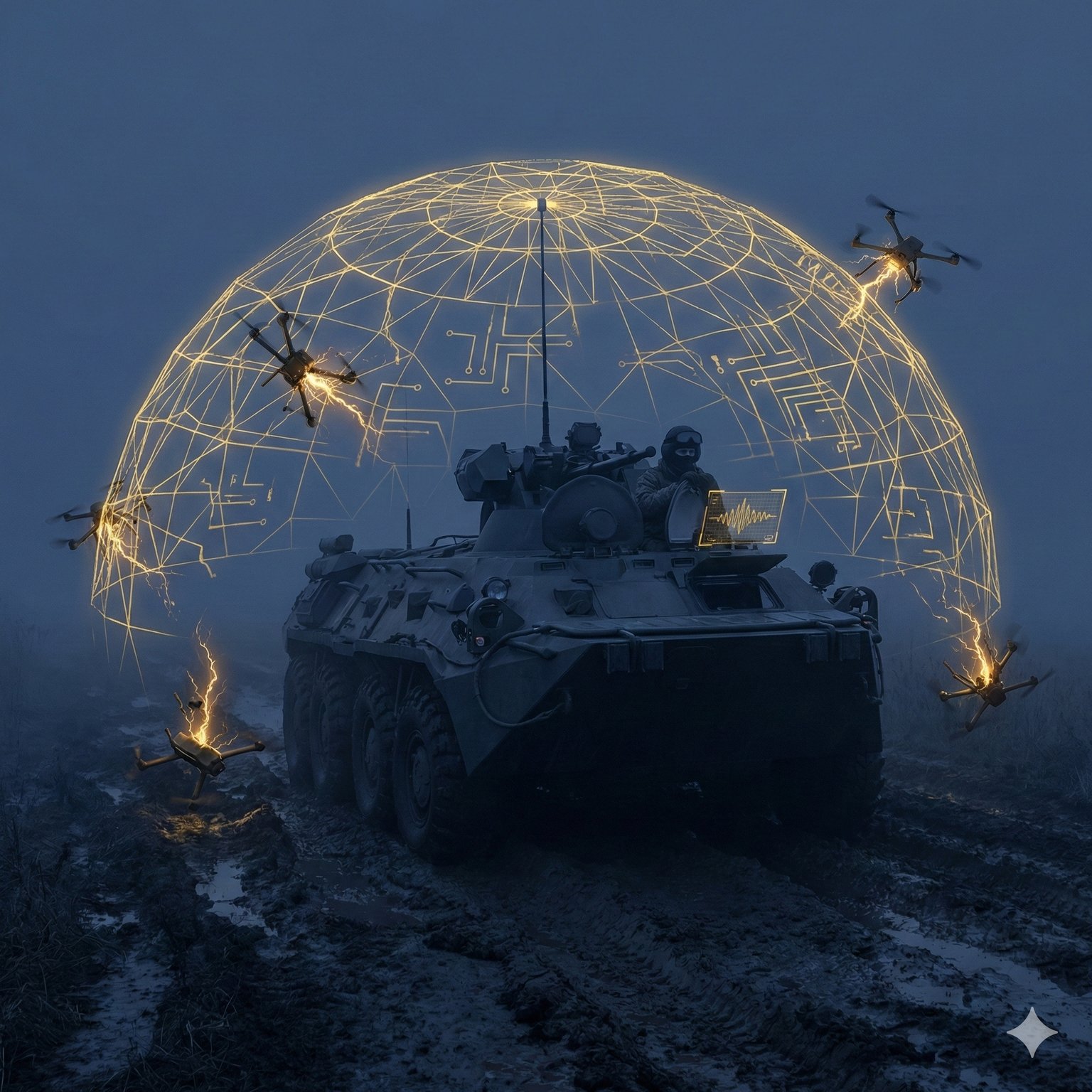
On the lit side of the beam nothing is hidden. On the other side four soldiers walk into weather no sensor has yet solved. That is the response in one frame: once being seen is the default condition, concealment stops being a state of nature and becomes something a force has to manufacture, continuously, at a price.
The cheap answer is to stop moving
The first counter‑measure is behavioral and nearly free: disperse, dig, cover the thermal signature, stay small and stay still. Its price is the thing armies exist to do. The corpus reads this as the central paradox of the period – the more the battlefield is seen, the less anything on it moves, and the front settles into fortified attrition rather than the maneuver that network‑centric theory predicted.
The expensive answer is the spectrum
Where a unit does have to move, the umbrella it moves under is electronic rather than steel. Russian sources converge on jamming, spoofing and control‑link disruption as what actually decides whether a vehicle survives, and the welded cage armor everyone photographs is only the visible layer of that architecture. Survivability is argued in decibels, not millimeters.
The fast answer is built in a dugout
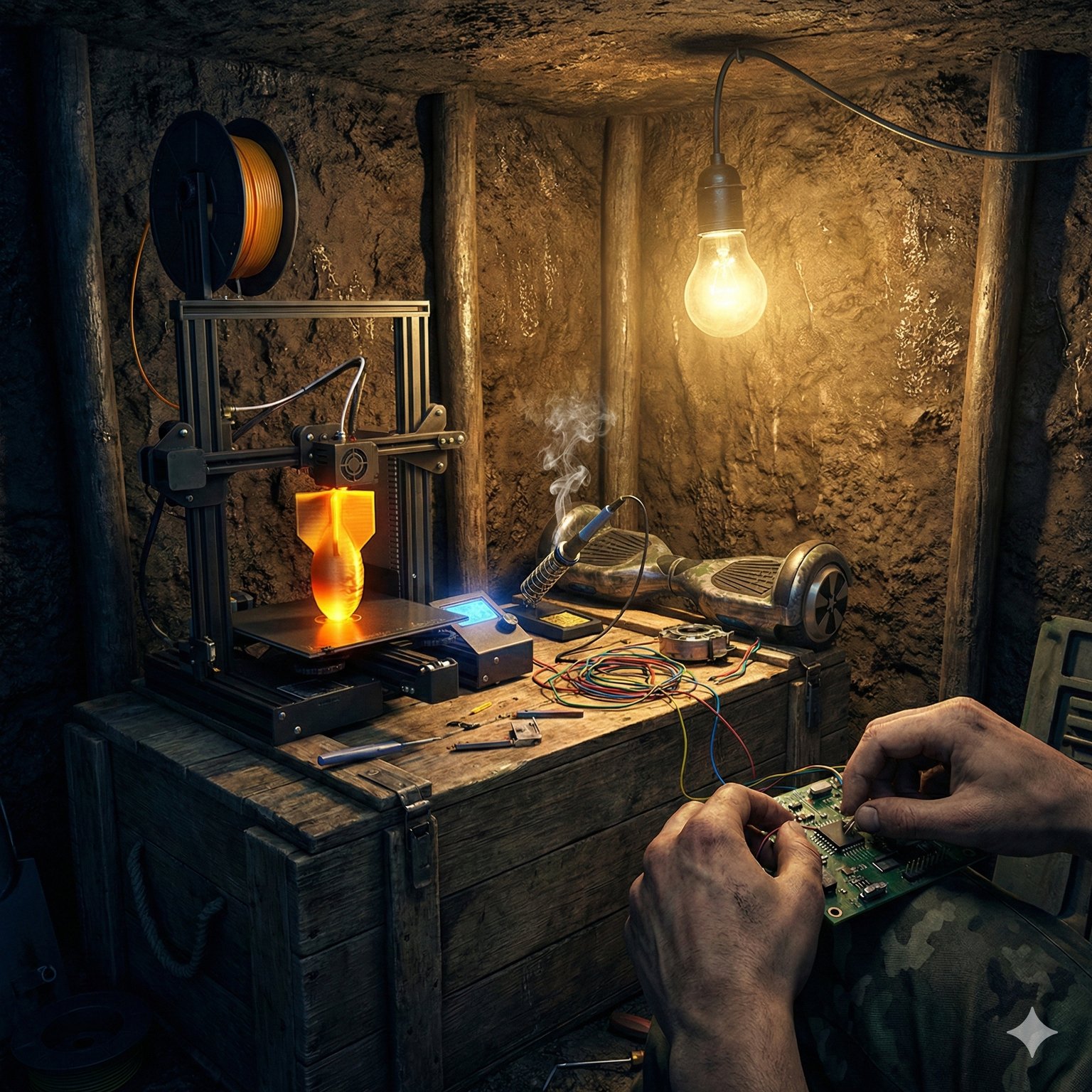
A printer, a soldering iron and a scavenged gyroscooter motor are a production line now. The corpus documents an adaptation loop that runs in days against a procurement cycle that runs in years: what fails is discarded within days, and what works is copied across the front within weeks, through the same channels we harvest.
And half of it is civilian
The other end of the same loop is a volunteer at a kitchen table modifying a consumer quadcopter. That fusion is what makes the adaptation fast, and it is also what makes the war legible to us: the openness that lets a volunteer network answer a frontline request in days is the openness that lets an analyst geolocate the video of the result.
26,142
unique text chunks
14
databases, official to frontline
13
taxonomic principles
Transparent Battlefield 25‑pager, 2026
Which is what makes it a measurement problem
None of this stays in Ukraine, and none of it is settled doctrine – it is an argument being conducted in public, in Russian, by sources that contradict each other. That is exactly the kind of object a corpus can measure rather than assert: 26,142 chunks from 14 databases, read through a 13‑principle taxonomy, so that ‘they are adapting’ acquires a denominator.
The cut closes on an instrument, not a verdict
Cut 3 is not really about drones. It is about a fast‑moving discourse that contradicts itself between official and frontline sources and leaves a written record dense enough to count – and the sharpest single result in it is not a technology but a gap: officials describe their communications as sufficient while operators say they cannot cope. That gap is only visible if you read both source families against each other and can say how much of each you read. Move 4 takes the same instrument off this one topic and points it at RFSDP, the master corpus, where the question can be put to Russian foreign, security and defense policy as a whole.
The master corpus nobody has seen
The evidence base of our own field, measured – on one logarithmic axis, so the sizes are comparable rather than impressive.
What our own field has published
Our own evidence base, measured on one logarithmic axis so the sizes are comparable rather than impressive.
And what it cites
Those works cite outward 1,122,391 times. The citation shadow is an order of magnitude larger than the literature itself.
The neighboring field, for scale
The neighbouring field publishes 429,038 works. Ours is not small because the subject is small.
The literature nobody has read
264,000 distinct works, 204,000 of them scholarly. No person and no team has read this, and none ever will.
And that is only the published half
RFSDP adds 9,130 publications and 30,879 outward references. The master corpus is the part we can actually audit.
A measured evidence base is the precondition, not the finding
“The literature says” is, in practice, a claim about a few hundred works somebody happened to encounter. Once the corpus has a number and a confidence interval attached to it, a reading of it can be shown, audited and disagreed with. That is what makes the cuts you have just seen defensible rather than merely interesting.
How we can help you
Not a product you buy. A pipeline built around your question.
Your question
It starts from your question, not from ours
Nothing here is a finished product you receive. You say what you need to
know and cannot currently find out, and everything downstream – the corpus, the
scheme, the extraction, the index – is built to answer that. If your question
changes the architecture, the architecture changes.
Tailored corpus
A corpus cut to it, not a feed handed to you
RuBase has collected roughly 296,381 chunks across 28 kinds of
source in eleven or more languages. What you get is a defensible slice of that:
harvested, deduplicated and documented, so you can say exactly what was read and
what was left out – which is the question a curated feed can never answer.
Extractions
Substantive extraction, not keyword counting
Each document is read against an explicit scheme rather than scanned for
strings, and what comes back is a structured record of what it actually says. That is
the step that turns a pile of sources into evidence you can query, count and audit.
Robust taxonomy
A scheme you can inspect and contest
The taxonomy is built, argued over and revised before anything is run at
scale, and it is yours to attack. Because it is explicit, the segments that come back
nearly empty carry as much information as the full ones: a hole in the wheel is a
finding about what the sources never discuss, not a gap in the data.
Interactive index
An index you walk, not a PDF you read once
The result is delivered as something you interrogate: an interactive index
over the whole corpus, down to the individual document. Anyone who doubts a number can
click through to the documents it was counted from, which is what makes a contested
reading defensible in front of a minister or a referee.
Briefs to scenarios
Outputs from a short brief to a full scenario set
The same stack carries a two-page brief, a teaching resource, a journal
submission or a set of empirically grounded scenarios. What changes between them is the
length and the audience, never the evidence: nothing is asserted in an output that
cannot be traced back to the documents underneath it.
You, throughout
You are in the loop, not at the end of it
Before anything runs we show the queries, the architecture and the sources,
and ask what is missing. Then the taxonomies, then the preliminary results and the
disagreements between the models that produced them. Each is a place to push back
while pushing back still changes the answer.
The whole argument, in one sentence
Here are the problems our field has, here is how we have tried to solve
them, and we are open about sharing all of it. The offer is to scholars rather than to
a region or an institution in the abstract: bring one question you cannot currently
answer, and we will build this chain around it with you – and tell you
honestly when the answer that comes back is that there is nothing there.
The MDTDF
Four levels, seven independent dimensions, and a cross-product no flat question list can reach.
Four levels
HLTP, second level, third level, taxon. Four levels, and every taxon inherits its whole path.
Seven, not one tree
Seven independent dimensions rather than a single hierarchy. No dimension determines another.
Seven positions at once
Every issue carries a position on all seven dimensions simultaneously, not one label.
The independence test
Classification on one dimension must not determine classification on any other. That is the test.
Why the cross-product is the whole point
A staffer’s question list is one dimension: 61 questions reach 61 cells, and the 62nd issue is the one nobody wrote down. Seven dimensions address their cross-product instead – 13 × 12 × 4 × 7 × 11 × 6 × 8 = 2,306,304 third-level positions – so the cells no single-dimension list can even name become addressable. Most of those cells will be empty or implausible, and that is the honest limit; the ones that are not empty are reached by arithmetic rather than by luck.
The murderboard
1 September 2026 · opened 10:12:56, dual GO 11:37:47 · blind round 1 plus eight adversarial rounds, two frontier models.
Two frontier models, and neither judged itself
Sol and Fable each wrote their own candidate every round; Opus was custodian only. Each verdicted the other’s work, never its own.
Round one was blind, and two dimensions came back the same
Neither model could see the other’s draft. Both produced Concerned Object and Temporal Reference, and both survived all eight later rounds.
Rounds two and three: both refused
Sol moved 440→469 taxa, Fable 448→420, and each refused the other twice. Refusal was cost-free by design.
The five-round hold
Fable conceded at round four. Sol withheld for five more rounds and closed only when its one named blocker was actually fixed.
Round nine: not agreement – the same bytes
Round nine closed on two independent verdicts, not on agreement. Both final files hashed identically.
What the dual GO buys, and what it does not
Both verdicts independently record that the taxonomy shows
no appropriation-structure mirroring: neither model was told about the
P-1/R-1/O-1 trap, and each enforced it from the domain definition alone. What a GO
approves is this taxonomy’s fitness for classifying the source corpus –
not the corpus, not the prompt, and not any downstream run. It has not yet been run
over a single budget document, and both verdicts say so.
Seven dimensions
One issue, classified seven independent ways at once.
What is wrong, and about what
The first two dimensions: the nature of the concern, and the object it attaches to. Independent by construction.
How big it is, and who it lands on
Scale and affected constituency vary freely against the first two. A small issue can land on a large constituency.
What is asked for, and about which time
Remedy sought and temporal reference. What the member wants done, and whether it is retrospective or forward-looking.
What the question stands on
Evidentiary ground: whether the claim rests on the budget document, on testimony, or on an outside audit.
Why seven dimensions and not one long list
A staffer’s question list is flat: one dimension, however long. Seven independent dimensions generate a cross-product instead, and the cells that no single-dimension list can reach are precisely the issues nobody thought to ask about. Fixing the instance as the politically actionable issue, rather than as a document or a programme, is what keeps the whole structure orthogonal to the Comptroller’s own P-1/R-1/O-1 filing system – a taxonomy of the documents would only have reproduced it.Both models’ final files are byte-identical · sha256 44b2cb719d87c8391d1899bd28775e4a973f1a3330fb56ee778f637b92228ae1
Inside a dimension
Nature Of Concern, drilled from dimension to taxon – every string below is read from the agreed TSV.
HLTP · 1 of 7
Nature Of Concern
4 · 13 · 107
2nd · 3rd · taxa
One dimension of seven
Nature Of Concern asks what kind of trouble is being named – strategy, money, delivery or propriety. It is one of seven independent dimensions, and on its own it holds 107 of the 498 taxa.
Strategic Alignment
3 third-level · 25 taxa
Cost And Affordability
3 third-level · 26 taxa
Execution And Performance
4 third-level · 32 taxa
Propriety And Compliance
3 third-level · 24 taxa
Four second-level elements
The dimension splits into four families of concern. Each is a complete way to be unhappy with a defence budget, and none of them predicts where the same issue falls on any of the other six dimensions.
Cost Growth And Estimation
8 taxa
Topline Affordability
8 taxa
Value For Money
10 taxa
Thirteen third-level elements
Cost And Affordability alone carries three of the thirteen. This is the level a staffer works at – specific enough to hand to an analyst, general enough to survive a change of programme.
Value For Money · 10 taxa
Duplicative programs pursued by different services
Requirements gold-plating inflating cost without benefit
Cheaper commercial alternative ignored
Poor cost-effectiveness relative to an available alternative
Excessive lifecycle cost for the capability delivered
Headquarters and overhead growth absorbing frontline resources
Heavy service-contract spending versus in-house capacity
Studies and demonstrations that never become fielded capability
Requirement tailored to a predetermined solution
Competition restricted without adequate justification
Ten real issues, not headings
Value For Money holds ten taxa; every third-level element holds eight to ten. These are politically actionable issues, not labels – which is why the cross-product surfaces questions nobody asked.
Inside a second dimension
Remedy Sought – what the legislator is actually asking for, drawn to scale.
One dimension, measured
Remedy Sought asks a single question: what is being asked for? Three
second-level elements open into eleven third-level elements holding 92 of the
taxonomy’s 498 taxa. The band is drawn to scale, so its widths are counts rather
than design.
Money: up, down, sideways
The first element is the one everyone expects. Nine taxa ask for more,
eight ask for less, and eight ask for the same total spent differently – a
reallocation is a distinct political act, not a smaller cut. Each row quotes one real
taxon; the badge opens all twenty-five.
Not about the amount at all
This element withholds, fences, restricts and authorises. A legislator can
leave every number in the request untouched and still change what the department may
lawfully do with it. Twenty-six taxa sit here and not one of them is a funding
figure.
The biggest element asks for answers
Forty-one taxa – nearly half the dimension – seek
explanation, reports, scrutiny or named responsibility. Open Or Deferred Response keeps
the scheme honest: an issue can be raised with no remedy specified, and there is still
a cell for it.
Why a second dimension is worth 92 more taxa
Remedy Sought is independent of Nature Of Concern by construction:
knowing that an issue is about cost growth tells you nothing about whether the staffer
wants a cut, a fence or a report. That independence is what makes the cross-product
real – seven dimensions multiply rather than stack, and the cells nobody has
filled are the questions nobody has thought to ask. Both frontier reviewers checked
this dimension against the appropriation structure and independently confirmed that it
mirrors none of it.
One issue, seven readings
One real congressional barracks issue, classified on all seven dimensions at once – and each answer leaves the other six free.
Dimension 1 · what is wrong
The first reading asks what kind of failure this is. Money was appropriated and spent, yet the backlog persists, so it sits under Execution And Performance. Nothing yet says who is hurt or what to do.
Dimension 2 · what it is about
The second reading asks what the money is for. Barracks are People, not platforms. Notice this did not follow from dimension one – the same outcome failure could as easily have been a submarine.
Dimension 3 · how far it reaches
Scale is reach, not dollars. One mouldy building would be Item And Unit Scope; a service-wide sustainment shortfall is Defense Enterprise Scope. The same concern about the same object sits at either.
Dimension 4 · who bears it
Barracks house junior enlisted personnel, so the burden falls on them and not on families, civilian employees or allies. This is where a constituent letter enters, independently of all three above.
Dimension 5 · what is asked for
The same facts support several asks. Here the committee wants a plus-up, but it could have demanded a report, fenced the funds or written a statutory restriction. Remedy is a genuinely free dimension.
Dimension 6 · which time
The request is about next year, but the argument is retrospective: a backlog built up over prior years distorts the sum asked for now. Time of the money and time of the argument differ.
Dimension 7 · on what basis
The last reading records what the claim rests on. A supreme audit institution finding is contestable in a different way from an internal briefing or a press report. Evidence belongs to the issue, not the topic.
Seven independent readings of one issue
Change any single answer and the other six stay valid – that is what dimensional independence means, and it is the test the framework applies. A staffer’s question list is one dimension and yields 498 flat labels; crossing the 61 third-level elements yields 2,306,304 cells. The cells nobody has visited are the issues nobody thought to raise.
Thirty years, not one
Why the budget corpus runs FY1998 to FY2027, and what that buys a congressional reader.
One year answers nothing
A single budget tells you what was asked for. It cannot tell you whether the ask is new, recurring, or a rebranding of something already refused.
Thirty years is the unit
FY1998 to FY2027. Long enough to cross four administrations, several defence reviews, and at least two changes in what counts as a threat.
What it makes askable
Not what does this year say, but how has the framing of this issue moved across administrations, which is the question a staffer actually has.
Where it starts
The FY2027 justification material is mirrored and validated. The earlier years are a harvest, not a hope: the documents exist and are public.
The taxonomy is the instrument; the thirty-year corpus is what makes it worth having. A classifier over one year is a curiosity. The same classifier over three decades is a time series, and a time series is an argument.